What Does Senior Care Actually Cost in Canada? A 2025-2026 Breakdown
Prices mentioned below are SeniorHome.ca estimates, not rates published by the communities. Ask each community for its current rates.
If you're helping a parent or loved one plan their next chapter, one of the first questions that comes up is: how much is this going to cost?
The answer depends on where they live, what level of care they need, and whether they qualify for government subsidies. Costs range from under $1,500 a month for a basic retirement residence in Quebec to over $18,000 for private long-term care in Metro Vancouver.
We pulled together the latest figures across every major care type and province so you can plan with real numbers, not guesses.
Average Monthly Costs by Care Type
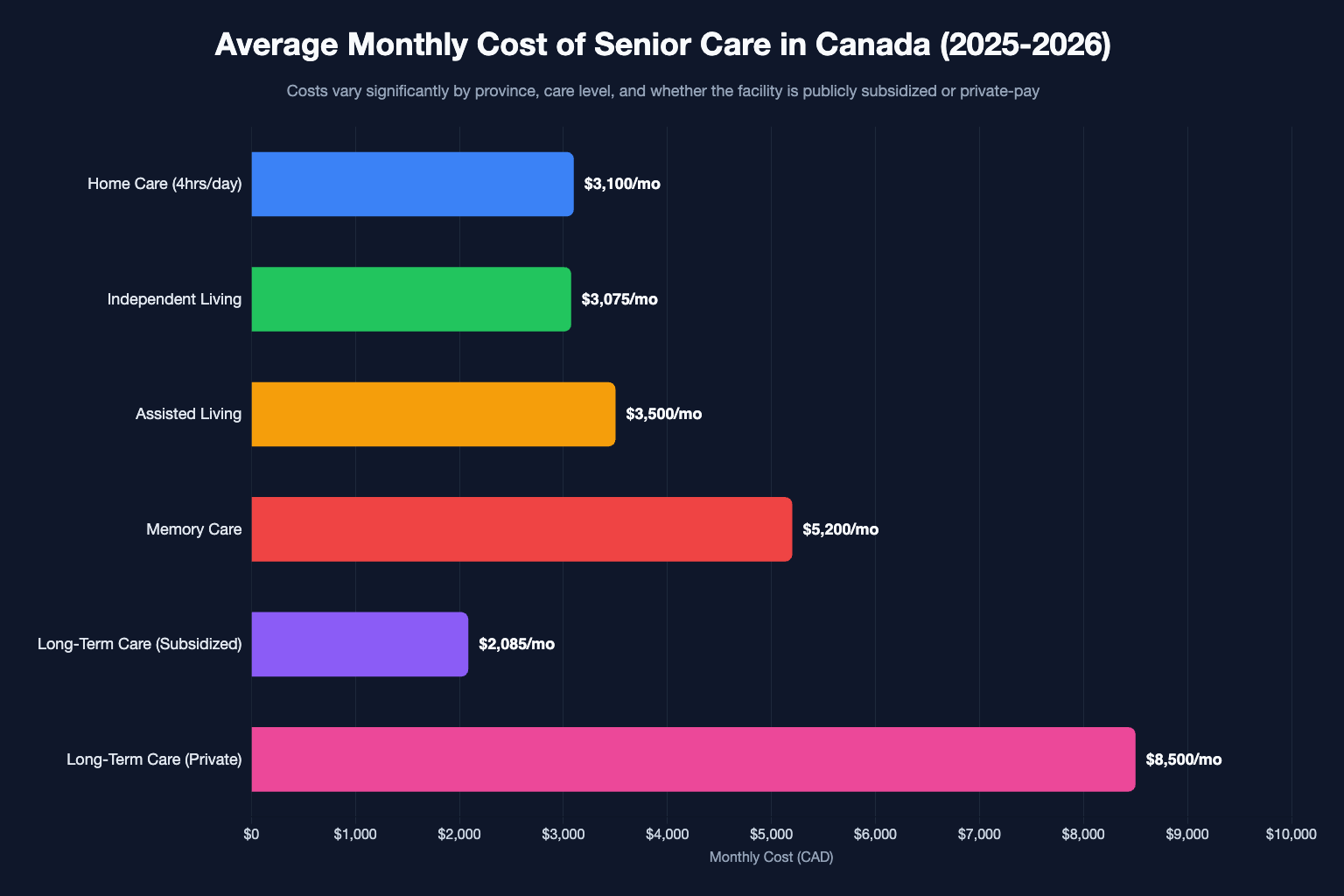
The chart below shows what Canadian families typically pay each month, depending on the type of care:
A few things stand out:
- Memory care is the most expensive option at $5,200/month on average, driven by 24/7 specialized staffing and secured units
- Subsidized long-term care is dramatically cheaper than private pay. In Ontario, the basic co-payment is just $2,085/month because the province covers the health care component
- Private-pay long-term care runs $8,500/month on average nationally, and can exceed $18,000 in Vancouver
- Home care at 4 hours/day costs roughly $3,100/month through a private agency, comparable to independent living
How Costs Vary by Province
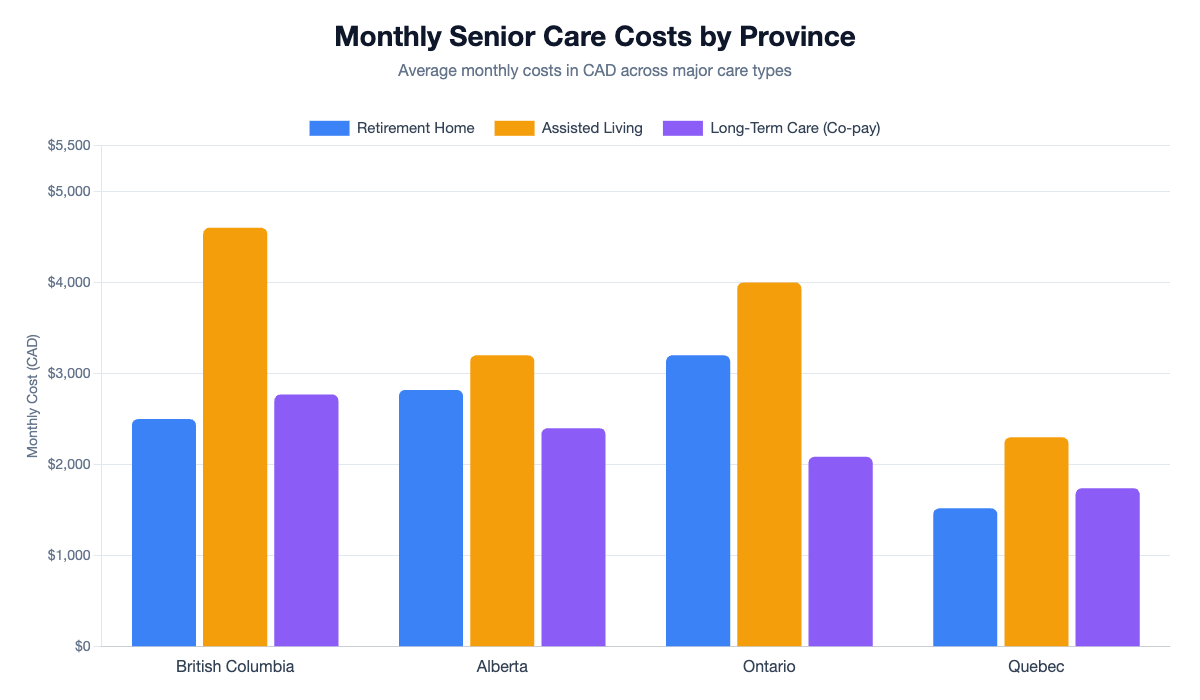
Where your loved one lives makes a massive difference. Quebec consistently offers the lowest prices in the country, while British Columbia and Ontario command premiums, especially in major cities.
| Province | Retirement Home | Assisted Living | LTC (Co-pay) |
|---|---|---|---|
| British Columbia | $2,500 | $4,600 | $2,770 |
| Alberta | $2,820 | $3,200 | $2,400 |
| Ontario | $3,200 | $4,000 | $2,085 |
| Quebec | $1,520 | $2,300 | $1,740 |
Quebec's retirement home average of $1,520/month is roughly half what Ontario charges, making it the most affordable province for senior living by a wide margin. Alberta sits in the middle, while BC's assisted living costs are the highest in the country at $4,600/month.
Keep in mind these are averages. A luxury retirement community in downtown Toronto can easily run $6,000 to $10,000 a month, while smaller towns in any province will be significantly cheaper.
The Real Cost of Home Care
Many families prefer to keep their loved one at home, but private home care adds up fast. Here's what agencies charge per hour across different service levels:
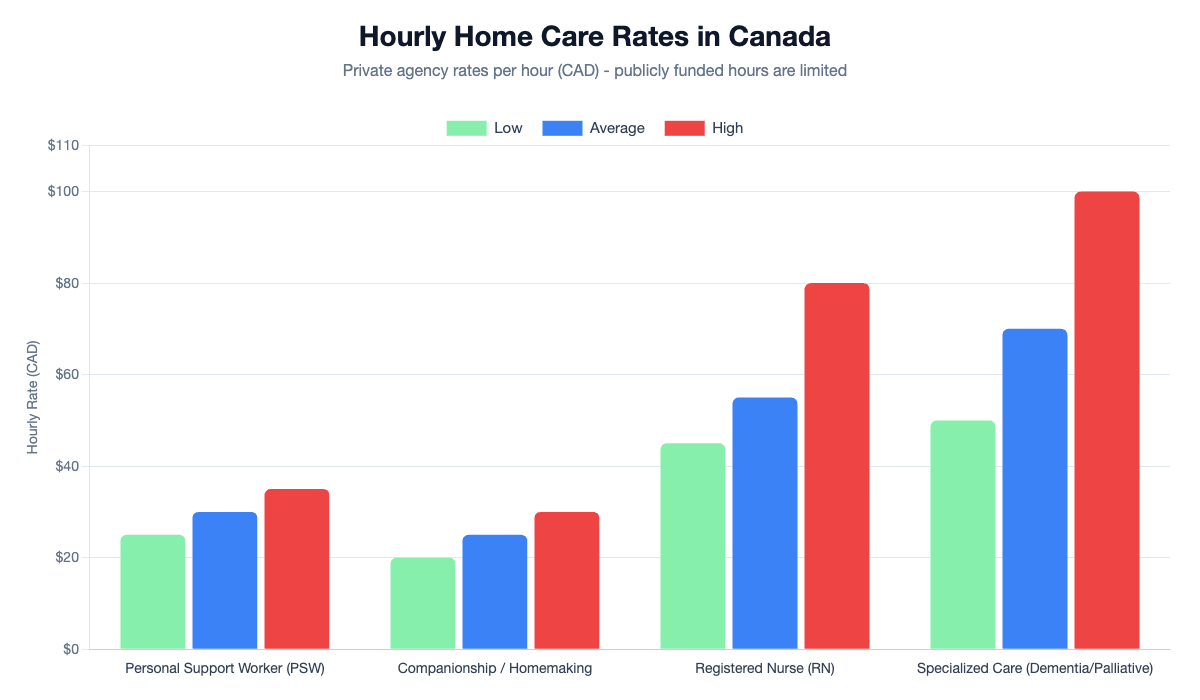
A personal support worker (PSW) at $30/hour for 4 hours a day, 5 days a week comes to roughly $2,600/month. Need a registered nurse for medication management or wound care? That jumps to $4,400/month at the same schedule. Round-the-clock home care can exceed $15,000 to $20,000 a month.
Every province offers some publicly funded home care hours through regional health authorities, but they're limited. In Ontario, for example, Ontario Health atHome may provide a few hours per week, but families often need to top up with private care.
Subsidized vs. Private Pay: What's Actually Covered?
This is where it gets complicated, and where the biggest savings hide:
What the government covers:
- Long-term care nursing homes — All provinces cover the health care component (nursing, medical, medications). Residents pay only for accommodation, which is regulated and often income-tested
- Basic home care — Assessed and provided by provincial health authorities at no cost, but hours are limited (typically 2-6 hours/week)
- Quebec CHSLDs — Fully public system where all care is covered and accommodation fees are income-tested through RAMQ
What you pay out of pocket:
- Retirement homes — Entirely private pay in every province. No government coverage
- Private assisted living and memory care — Not subsidized unless you secure a funded bed (rare, with long waitlists)
- Extra home care hours — Anything beyond publicly funded allocations is private pay at $25 to $100/hour
Many middle-income families fall into an affordability gap: too much income to qualify for subsidized beds, but not enough to comfortably pay $3,000 to $5,000 per month indefinitely.
The Waitlist Reality
Even if you qualify for subsidized care, getting a spot is another story. Over 50,000 Canadians are currently waiting for a long-term care bed. In British Columbia, the average wait time has nearly doubled from 146 days in 2018 to 290 days in 2024.
This means many families end up paying for private care while they wait, turning what should be a subsidized cost into months (or years) of private expense.
What You Can Do Right Now
If you're starting to plan for a parent's care, here are concrete steps:
- Get a needs assessment early. Contact your provincial health authority to understand what public services your loved one qualifies for. Don't wait until it's urgent
- Tour communities in person. Prices vary enormously even within the same city. Use SeniorHome.ca to compare options by location, care type, and budget
- Ask about rate reduction programs. Ontario, Alberta, and other provinces offer financial assistance for residents who can't afford the basic long-term care co-payment
- Factor in the full picture. A $3,000/month retirement home that includes meals, housekeeping, and activities may actually be cheaper than maintaining a house plus paying for groceries, property taxes, and occasional home care
- Start the waitlist conversation. If long-term care is likely in the future, getting on waitlists early gives you more options when the time comes
Senior care is one of the biggest financial decisions a family can face. The more you understand the real numbers, the better positioned you'll be to find the right balance of care, comfort, and cost.
All figures are in Canadian dollars and reflect 2025-2026 data from provincial health authorities, CMHC, and industry sources. Actual costs vary by specific location, facility, and level of care required.